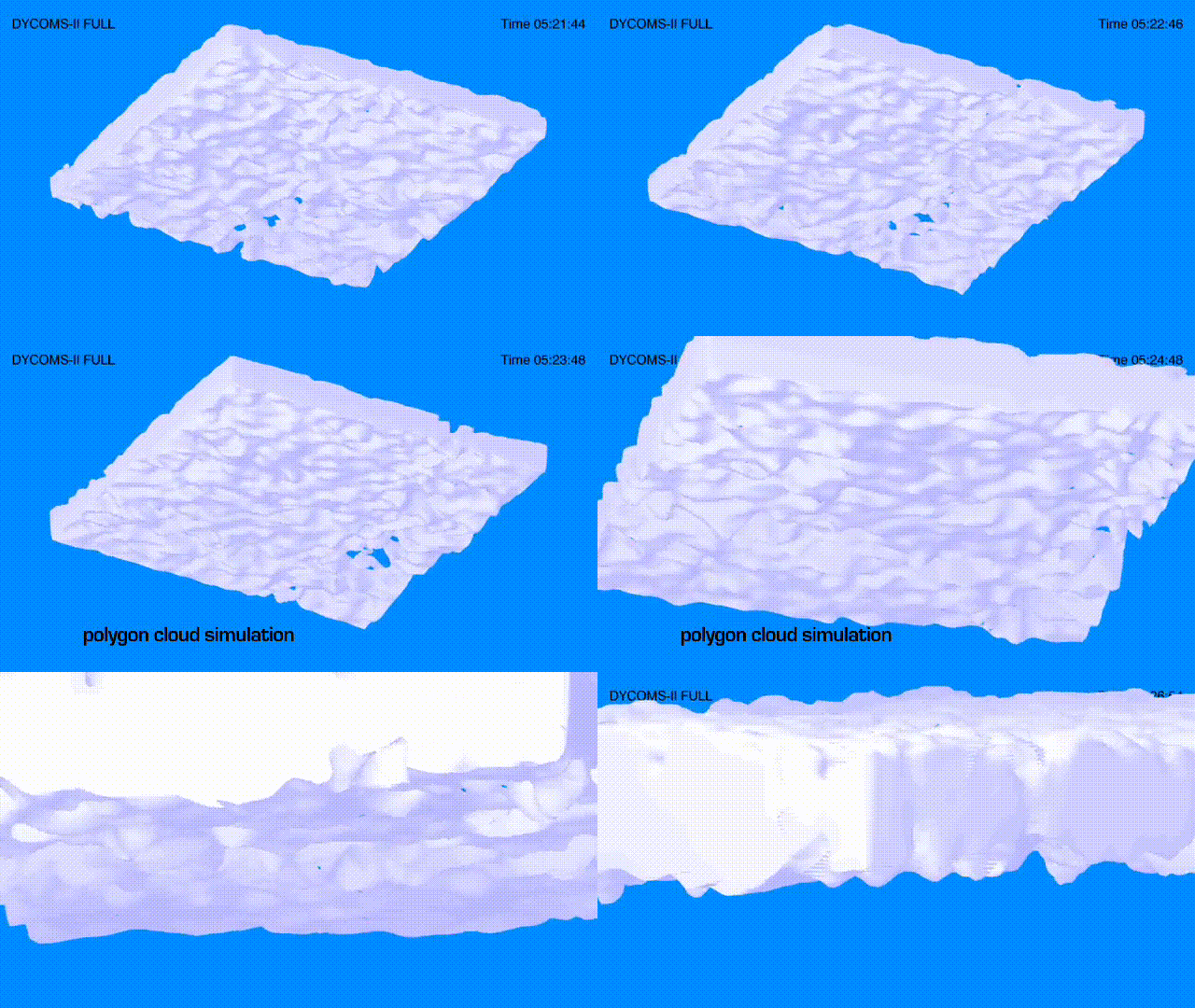
Despite decades of analyzing satellite and simulation data, scientists have barely begun to predict clouds. behavior or to understand their major influence on the atmosphere and global climate.
Many questions remain. For example, how do cloud particles form, interact and precipitate or re-evaporate? What determines the number of clouds in a given area? How do clouds interact with turbulence and visible and infrared light?
David Randall, an atmospheric scientist at Colorado State University, leads a team seeking answers to those questions and others with a new global cloud-resolving model (GCRM) that will use computers to portray Earth’s atmosphere in 10-second snapshots.
The GCRM, part of DOE’s Scientific Discovery through Advanced Computing (SciDAC) program, is built on a geodesic grid that consists of about 100 million mostly hexagonal columns, each with 128 levels. The 128 layers will cover a layer 50 kilometers up from earth. For each of these grid cells, the model predicts the wind, temperature and humidity at points just 4 kilometers (and eventually 2 kilometers) apart. That’s an unprecedented resolution; most global atmospheric models provide detail at a 100-kilometers scale.
“No one has done this before in quite this manner, and it’s our hope that our project will point the way to future generations of models,rdquo; says Randall, a member of the Intergovernmental Panel on Climate Change (IPCC) science team that shared the 2007 Nobel Peace Prize with former U.S. Vice President Al Gore. Randall was a coordinating lead author of a chapter about climate model evaluation in the IPCC’s final report.
Computer speed is of the essence. The model is using 80,000 processors on Jaguar, the Cray XT supercomputer at Oak Ridge National Laboratory (ORNL). Even with that much computational punch, the GCRM can complete only a few simulated days per wall-clock day of calculation. Data archival speed and capacity also are critical. A run of just a few simulated days can easily produce several petabytes (quadrillion bytes) of output.
Randall and his colleagues succeeded in a brief test of the GCRM and in the next couple of months they will aim at capturing two simulated days. The project’s goal before it ends in 2011 is to run and archive an entire simulated year. Simulation of an annual cycle will be a landmark, Randall says, because a year represents the basic unit of climate.
“There are three things we’ve wrestled with in building the GCRM,” Randall says. “One is which equations we should be using. The second is finding the right methods to solve the equations. And the third is getting a computer to actually compute the solution fast enough to be useful.”
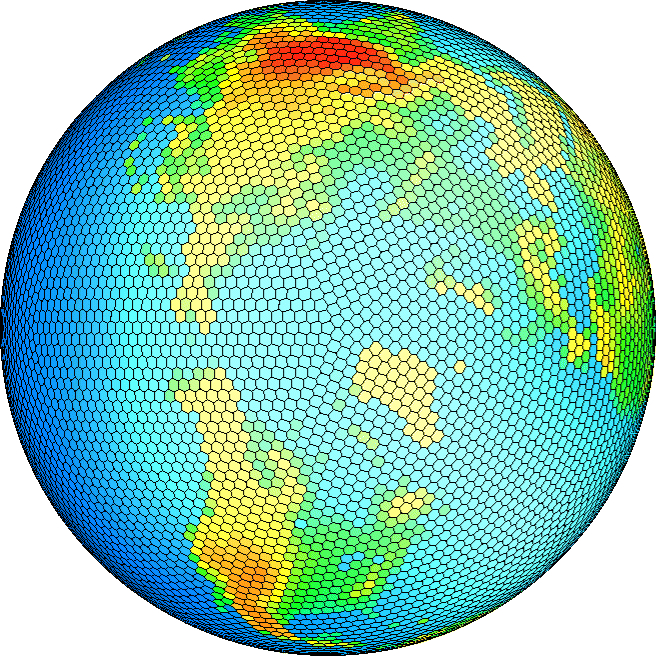
Researchers working on the Design and Testing of a Global Cloud-Resolving Model project under SciDAC are calculating wind, temperature and humidity at data points distributed on a three-dimensional grid distributed around the globe. This shows how such a grid will be deployed, but the project places the points closer together – as little as just 4 kilometers apart.
Modelers predict weather by solving partial differential equations representing physical conservation laws for mass, energy and momentum. The 10-second time steps enable the GCRM to simulate individual clouds’ growth and death. The equations describe how things change with time and how properties of the air evolve as it moves and the sun rises and sets.
Randall elaborates: “If you have, for instance, a little chunk of air moving around and you have some humidity there, an equation in the model says the humidity of that air will stay the same” – unless one or more of several variables change the outcome.
“Basically, the equation says that humidity doesn’t change except when one of these things happens, and then it changes this way. Then we have to write more equations to tell how these humidity-changers work. The model ends up being a system of equations that are all coupled and have to be solved simultaneously.”
The equation set, developed by UCLA’s Akio Arakawa and Colorado State’s Celal Konor, eliminates sound waves. “The atmosphere can make lots of different kinds of waves, but in choosing equations we knew we wanted to avoid those that include sound waves because sound waves are completely irrelevant to weather and climate,” Randall says.
Rather, Randall’s team has selected equations that directly describe the evolution of vorticity in clouds, or their “spinning motion,” Randall says. Vorticity “is really at the core of much of the important fluid dynamics in the atmosphere. Vortices move around and maintain their identities and live a life, like little animals. Sometimes two vortices will merge and make a bigger one.”
Cirrus clouds block infrared radiation from flowing out to space, and that tends to warm the climate.
This vorticity approach, developed by Arakawa and Colorado State’s Joon-Hee Jung, will be particularly useful for simulating large thunderstorms, which are important for global atmospheric circulation.
These storms pack a lot of energy in the form of updrafts that move, in extreme cases, 30 to 40 meters a second – “scary fast,” Randall says. They “lift air from near Earth’s surface to way up near the stratosphere in just a few minutes.”
Models must account for these and other physical properties, including matter – that is, water.
Besides moisture and momentum, “thunderstorms carry other things (carbon dioxide and other chemical species) through great depths of the atmosphere very quickly.”
Cumulus clouds, Randall says, make the upper troposphere wet by transporting water from its source, the oceans. “A lot of it will rain out along the way, but some of it is still left and it gets spread out up there and makes cirrus clouds, comprised largely of ice, which are very important for climate. We’re especially interested to see how storms that create cirrus affect the climate.”
Cirrus clouds block Earth’s infrared radiation from flowing out to space, and that tends to warm the climate, Randall says. “If we have more cirrus in the future, that will enhance warming. If we have less, it will reduce the warming.”
The GCRM also will give scientists new insights into tropical cyclones, “dangerous but very beautiful, very powerful storms that the GCRM will simulate quite well because of its extremely high resolution,” Randall says.
“Tropical cyclones are much bigger than thunderstorms, and in fact they contain many thunderstorms simultaneously. They affect the climate in part by cooling the sea surface as they move over the ocean”.
Besides Arakawa, Konor and Jung, Randall’s co-investigators are Colorado State’s Ross Heikes and Pacific Northwest National Laboratory’s Karen Schuchardt and Bruce Palmer. Randall also directs the Center for Multiscale Modeling of Atmospheric Processes, sponsored by the National Science Foundation.
The DOE work is part of the five-year Climate Change Prediction Program (CCPP) project, sponsored by DOE’s Office of Biological and Environmental Research. CCPP and SciDAC comprise the two cores of DOE’s Climate Modeling Program.
The simulations at ORNL enlist 2 million processor hours on Jaguar and are supported by DOE’s Innovative and Novel Computational Impact on Theory and Experiment (INCITE) program.
“These very high-powered computing systems that INCITE is making available are absolutely essential to the project,” Randall says. “We could not do this work without them.”
For now, Randall says, “the GCRM will do a few simulated weeks at most because computers aren’t fast enough to run any longer than that. But in the next couple of years we’ll be able to do whole years with the GCRM, 10-second chunks at a time.”
In the next 15 years, he predicts, forecasters will “be able to do decades and centuries with models like this.”