There’s no way around it: For now, we can’t live without coal.
Today it provides more than 40 percent of all the world’s electric power — about as much as oil, gas and nuclear fuels combined. About half of U.S. electricity and nearly 80 percent of electricity used in China comes from coal, and existing coal-fired power plants are expected to be in service for decades.
Although we can’t cut the coal connection for now, researchers at the Department of Energy’s National Energy Technology Laboratory (NETL) and Oak Ridge National Laboratory (ORNL) are using high-performance computers to help perfect one of the most promising ways to use it cleanly. Their simulations already have shed light on ways to improve coal gasifier designs, and an allocation of millions of computer processor hours will accelerate their work.
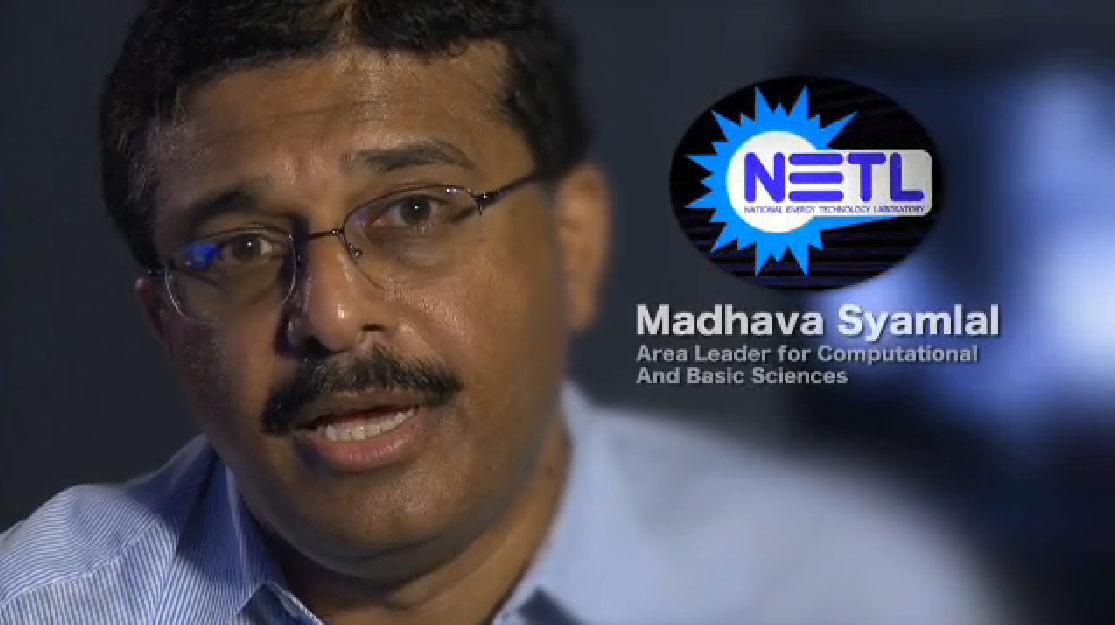
The models they develop also could have a wide-ranging impact on carbon-based alternative power generation, says Madhava Syamlal, the project’s leader and area leader for computational and basic sciences at NETL. “Municipal waste combustion, biomass, combined coal and biomass — they’re all flows using a gas and solids,” Syamlal explains. “We can use our models to describe all these systems.”
Gasification, the cleanest coal-based power system available today, uses heat, pressure and steam to turn carbon-containing material into synthetic gas (syngas), a mixture of carbon monoxide and hydrogen. Besides power-plant fuel, syngas can be used to produce liquid fuels, chemicals or pure hydrogen gas — itself an ultra-clean fuel.
Power production from syngas generates about as much carbon dioxide (CO2) as traditional coal-burning plants. But the CO2 produced by integrated gasification combined cycle (IGCC) plants is more easily captured than that produced by older designs. IGCC plants also have other advantages over older designs, including far better control of nitrous oxides, sulfur and mercury emissions. That makes it easier to cut or control the plant’s climate-changing and hazardous discharges.
Now the MFIX team is working with design engineers to move from experimental-scale gasifiers toward development of efficient commercial-scale gasification.
Syamlal and his team at NETL model conditions inside the transport gasifier, the high-pressure chamber where a source of carbon — coal — reacts with steam and air at high temperature in a reducing atmosphere to produce syngas. Besides factors like the size and shape of the reaction chamber, the computer model includes variables as diverse as temperature and pressure, coal analytes (ash and volatile gas content, percent fixed carbon and similar factors), gas and fluid flows, and the packing of moving solid materials.
“The basic idea here is to use physics-based models for describing gas-solids systems,” Syamlal says. “We use a continuum approach, treating coal particles — solids — as a fluid superimposed on a gas — essentially air, steam and other gases.”
It’s possible for experiments to determine all the physical processes occurring in a gasifier, but by running MFIX (Multiphase Flow with Interphase Exchanges), NETL’s open-source code, the group can predict how varying conditions will affect a commercial-scale reactor’s performance.
“Imagine a long pipe,” Syamlal says. “From the bottom, you inject char — carbon and minerals from coal. Coal also has volatiles. When you heat coal, volatiles and some moisture come out. Then you’re left with char.”
Air and steam are injected into the pipe at a point above the char’s injection point. Oxygen reacts with the char, burning the carbon and yielding oxidized carbon — carbon monoxide (CO) — and hydrogen gas (H2). This is drawn off as syngas over several cycles. New pulverized coal is injected even higher in the tube. Roughly 10 times as much char as newly injected coal cycles through the reactor as it runs. The process continues until the char’s carbon is entirely converted to syngas.
The injected coal heats but doesn’t burn because oxygen is depleted by burning in the lower part of the reactor. At the top of the pipe, the syngas is separated and char is re-cycled to the base of the pipe.
“Computationally, once we are confident in the model, we can see what happens to the injected coal. How far does the coal go, how is the mixing taking place, what is the oxygen penetration? We can look at all those in detail and that helps,” Syamlal says.
The MFIX-based model was validated with data from a pre-commercial-scale transport gasifier, part of a 13-megawatt demonstration thermal power plant. The model revealed some surprises about the behavior of materials within the black box of the working gasifier.
Syamlal offers an example: Engineers “hadn’t expected oxygen that is coming from the bottom part of the gasifier would penetrate above the level where coal was injected. If the oxygen penetrates to that point, essentially it burns all the good gas — the volatiles that come off when coal is first heated. What we actually want is for the oxygen to burn the carbon (from char), which is cycled into the gasifier at a point below where the coal is injected.”
Design engineers later inserted a probe and measured actual oxygen concentrations. The tests confirmed the predictions and designers were able to reconfigure the gasifier to eliminate the problem.
Such experiments and reconfigurations are impractical as new power plant designs scale up, so having good models becomes critical. The MFIX gasifier model can help predict problems in the design phase rather than after the next gasifier is built.
Now the MFIX team is working with design engineers to move from experimental-scale gasifiers toward development of efficient commercial-scale gasification in an IGCC plant — a scale-up factor of 50. In 2007, the code’s potential for driving better, faster and cheaper advances in clean coal power earned it one of R&D Magazine’s R&D 100 Awards as one of the year’s most promising new technologies.
MFIX solves a set of 22 time-dependent equations in three dimensions that portray the behavior of heavily loaded reactive gas/particle flows. It’s a general code that calculates the hydrodynamics, heat transfer and chemical reactions in fluid-solids systems, giving transient data on the three-dimensional distribution of pressure, velocity, temperature and mass fractions of chemical types.
When applied to coal gasification, MFIX calculates time-dependent information on conditions in the gasifier, including pressure, temperature, moving-material velocities, void fraction (the ratio of volumes of empty space to materials) and the composition of materials throughout the reactor. In a coal power plant, those materials include steam, oxygen, carbon monoxide, carbon dioxide, methane, hydrogen and nitrogen, as well as coal, coal tar, solid carbon, ash, volatiles and moisture remaining in the char.
Running on Jaguar, ORNL’s Cray XT supercomputer, MFIX was used to look in detail at how the behavior of a critical gasifier element — the injection ports through which oxygen, air and steam enter the system — changes performance. Now ORNL’s computers will enable high-quality simulations of how gases and solids physically move through the whole gasifier in a range of potential operating conditions.
“We had run on tens or hundreds of processors before because the machines we had were only that size,” Syamlal says. With Jaguar, “we can use thousands of processors.”
To capitalize on that power, the group received an allocation of 13 million processor hours from DOE’s Innovative and Novel Computational Impact on Theory and Experiment (INCITE) program. Syamlal’s team will use ORNL’s Cray XTs to model gasifier conditions in finer detail.
The step up in computational power will allow the team to approach modeling the gasifier at a scale practical for use in designing and building a full-sized commercial power plant. That’s a crucial next step toward incorporating into the world’s energy grids a new generation of coal-fired power plants that will burn solids more cleanly and efficiently.
And, Syamlal says, “The biggest issue is of reducing CO2. How do we reduce CO2? What we want to do is take it out of the power generation cycle and store it away forever so it doesn’t get into the atmosphere. For doing that, there are many technologies being looked at. But our studies show IGCC appears to be the most cost-effective way of utilizing coal.”