Gasifying coal to produce hydrogen and other synthetic fuels is an ambitious project in its own right. But DOE’s Office of Fossil Energy (FE) is taking the process a step further with the FutureGen power plant project, which seeks near-zero-emissions combustion technology that not only produces fuel but also sequesters carbon dioxide the process generates.
FutureGen would equip coal-gasifying power plants with advanced carbon capture and storage (CCS) systems and would make fuels for what are known as “ultra-lean, premixed combustion systems.”
Premixed systems mix fuel and air before they enter the combustion chamber. Lean-premixed systems have the potential for clean, efficient, fuel-flexible systems; they operate at high efficiency and burn gas at lower temperatures to generate low emissions of nitrous oxides (NOx).
Nonetheless, “most industrial flames are not premixed,” says Paul Ronney, a University of Southern California mechanical and aerospace engineering professor and a combustion-engineering expert. “At ignition, you have pure air meeting pure fuel at high temperatures that produces excess nitrous oxides emissions.”
It’s difficult to design safe and reliable systems based on premixed combustion, John Bell, Lawrence Berkeley National Laboratory (LBNL) senior scientist, noted in an FE research review. In non-premixed systems the flame location and stability are controlled by the mixing of fuel and oxidizer; premixed flames require device-scale stabilization. Developing such systems is particularly challenging for the hydrogen-rich fuels the gasification process produces.
The swirler makes the flow expand and slow down as it exits the nozzle, stabilizing the flame.
The dilemma shows “there are significant gaps in our understanding of combustion,” Bell says. “Theory provides a foundation for basic flame physics but can’t address the complexity of realistic flames. Laboratory measurements are difficult to make and limited in the detail they provide. Computation, with its ability to deal with complexity and unlimited access to data, has the potential for closing the gap between theory and experiment and enabling dramatic progress in combustion science.”
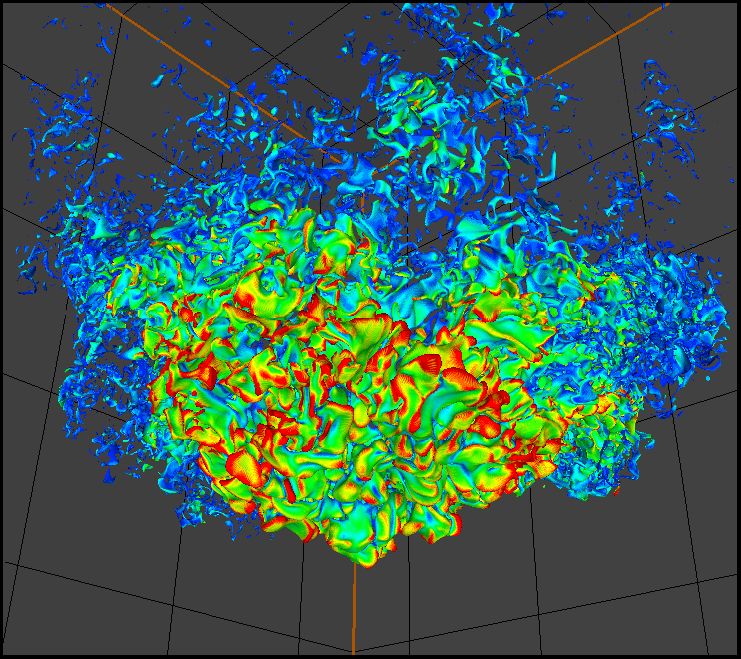
This snapshot of a hydrogen-air flame simulation is taken from below the flame, looking up. It shows an isotherm in the flame zone, colored by the local rate of fuel consumption, with red areas burning intensely and blue areas extinguished. J. B. Bell, R. K. Cheng, M. S. Day, V. E. Beckner and M. J. Lijewski, “Interaction of turbulence and chemistry in a low-swirl burner,” SciDAC 2008, J. of Physics: Conference Series, 125, 012027, Seattle Washington, July 2008.
High-performance computers, for instance, allow simulations to incorporate multiple spatial scales, from the size of the burner down to the thin reaction fronts that make up flames, Bell argues in the FE review. They also let computational scientists couple equations portraying flame chemistry with equations portraying fluid motion and molecular transport.
Such detail is necessary because lean premixed combustion occurs at a level where the interaction of turbulence and chemistry with molecular transport effects can drastically alter flame dynamics, sometimes leading to tiny flame extinctions.
One reason premixing isn’t yet widely used is that “lean pre-mixed flames are highly susceptible to combustion instabilities,” Bell says. To address the problem, he’s been running computational studies of low-swirl burners.
In 1991, LBNL scientist Robert Cheng developed a novel low-swirl aerodynamic flame stabilization method using burners equipped with a patented vane swirler resembling the inside of a jet engine. The swirler makes the flow expand and slow down as it exits the nozzle, stabilizing the flame.
Low-swirl burners using an ultra-lean premixed flame emit 10 to 100 times less NOx than conventional burners, which means they have the potential to significantly reduce smog.
In the United States alone, ultra-lean low-swirl combustion (ULLSC) would remove about 740,000 tons per year of nitrogen oxides from the atmosphere, Cheng says. That’s equivalent to the emissions of nearly 100 coal-fired power plants. Natural gas burners in boilers, furnaces and turbines are the primary candidates for ultra-lean, low-swirl technology.
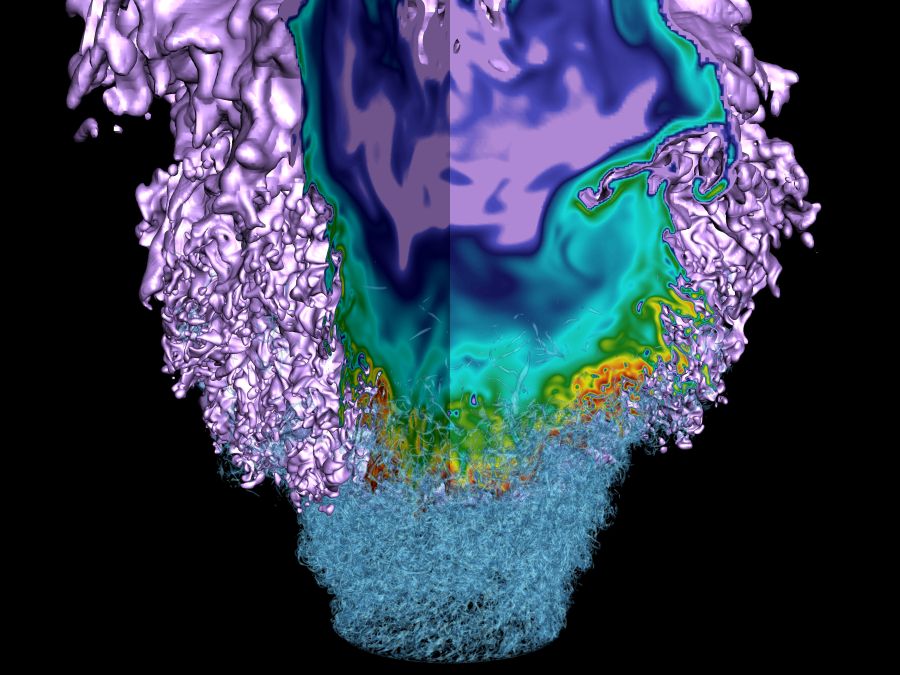
Bell and his team, which includes LBNL scientists Marcus Day, Mike Lijewski and Vince Beckner, have simulated a low-swirl burner fueled by methane and hydrogen. Their model used the novel techniques of low Mach number with adaptive mesh refinement, which dynamically focuses computational effort where it is needed during a simulation.
Even with these techniques, the simulations required 3 million processor hours on high-performance computers at the National Energy Research Scientific Computing Center (NERSC) at LBNL; the simulations would have been impossible without these methods.
“Low Mach number basically means the simulation is ignoring the effect of passing sound waves on the flame,” Ronney says. “It saves having to simulate the effect of yet one more variable whose effects aren’t that critical.”
One variable that does have a dramatic effect is fuel choice, Bell says. Turbulent air movement, for instance, has a much greater impact on a hydrogen flame than on a methane flame.
A distinctive feature of a low-swirl burner is that the flame is aerodynamically stabilized, resulting in a detached flame that sits above the burner. Although this type of stabilization is more difficult to design, detached flames don’t lose energy to the burner, so they not only produce fewer emissions, but also are more efficient. This design also reduces wear on burners and permits fabrication from more economical components that aren’t specially designed for high-temperature conditions.
With all these advantages, industry is taking notice. The Maxon Corporation of Muncie, Ind., recently licensed ULLSC technology for industrial heaters used in baking and drying ovens, which in the United States consume more than 9.8 quadrillion BTUs of natural gas a year. Another manufacturer evaluated a ULLS burner for use in a home spa heater. Solar Turbines of San Diego investigated ULLSC in natural gas turbines that generate electricity in place of coal-fired steam turbines.
“Natural gas turbines are smaller, cleaner and much cheaper than steam turbines. They work especially well during peak energy times as backups for the larger systems,” says Ronney, who grew up in Los Angeles when the city had a brown, unremitting haze. He credits combustion research for the clean air he now enjoys.